
A 20-year-old university student was concerned about her appearance due to the presence of a pointed tooth in her mouth. She visited a dentist for seeking consultation with regards to her concern. She informed the dentist that she noticed a pointed tooth in her upper front tooth region since her childhood. Even though the tooth in question did not cause her any physical harm, she suffered a lack of confidence in social circles and avoided smiling due to the worry of displaying her abnormal tooth in public. She wonders why fate has punished her with such an ugly looking tooth.
The development of tooth also known as ‘Odontogenesis’ is a complex biologic process which begins during the development of embryo in the mother’s womb. This process continues into the childhood resulting in the formation of two sets of teeth in an individual’s life, namely, the ‘milk teeth’ and the ‘permanent teeth’. Additionally, there are complex genetic mechanism which dictates the type of tooth (its shape and size), and its location in the mouth. In this regard, the milk teeth show three types of teeth: the incisors, the canines and the molars; whereas the permanent teeth show 4 types: the incisors, the canines, the premolars and the molars. Any disturbance during the development of tooth or a genetic defect may affect the shape, size and texture of the tooth. Such disturbances are known as ‘developmental anomalies of teeth’. The tooth in the above scenario is a case of an anomaly called the ‘peg lateral’ which results in a pointed tooth in the mouth.
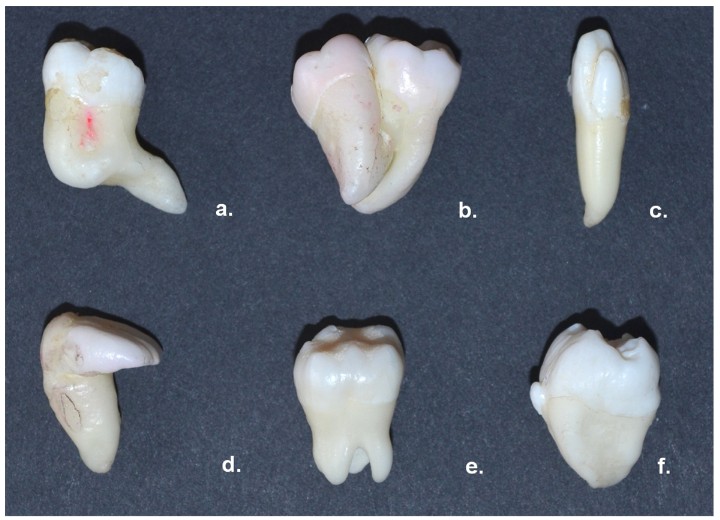
Humans can be affected by a range of developmental anomalies which can affect the shape, size, number, position or the structure of the tooth. Such anomalies as seen in a small number of population and reflect a genetic defect or some disturbance during the developmental stage of the tooth. Such teeth may present with a number of anomalies in shape (see image) and this could have serious consequences in proper maintenance of oral health for an individual. Teeth that are more or less than the normal number of teeth although normal in shape and size might have secondary problems related to the oral hygiene. Moreover, it is important is to recognize the anomalies that affect the structure of the tooth as the teeth in such cases have very poor quality and could result in severe deterioration or total loss from the mouth which in turn could cause serious ramifications for the individual. It is therefore important to be aware of such developmental anomalies and consult a dental specialist at the earliest in order to have a confident smile and a healthy mouth. Both are important for the overall well-being of an individual.
Assistant Professor Dr. Vinay Marla
Faculty of Dentistry
Qaiwan International University
REFERENCES
Shrestha A, Marla V, Shrestha S, Maharjan IK. Developmental anomalies affecting the morphology of teeth – a review”, RSBO. 2016 Mar; 12(1): 68–78.
Balic A. Concise Review: Cellular and Molecular Mechanisms Regulation of Tooth Initiation. Stem Cells. 2019 Jan;37(1):26-32. doi: 10.1002/stem.2917.
McKinney R, Brizuela M, Olmo H. Developmental Disturbances of the Teeth, Anomalies of Shape and Size. [Updated 2025 Feb 15]. In: StatPearls [Internet]. Treasure Island (FL): StatPearls Publishing; 2025 Jan-. Available from: https://www.ncbi.nlm.nih.gov/books/NBK574555/
Thesleff I. The genetic basis of tooth development and dental defects. Am J Med Genet A. 2006 Dec 1;140(23):2530-5. doi: 10.1002/ajmg.a.31360.
Tucker AS, Sharpe PT. Molecular genetics of tooth morphogenesis and patterning: the right shape in the right place. J Dent Res. 1999 Apr;78(4):826-34. doi: 10.1177/00220345990780040201.